
Application Deadline: September 14, 2025.
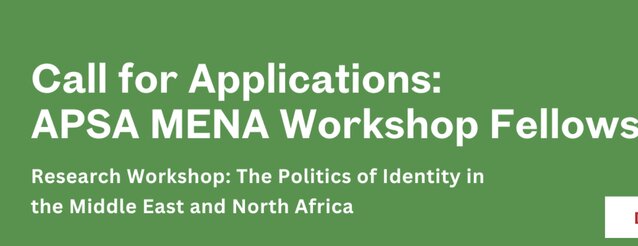
Applications are now open for the 2026 APSA MENA Workshop Fellowship. The American Political Science Association (APSA) is pleased to announce a Call for Applications from early-career scholars who would like to participate in a four-day in-person workshop that examines the theme of participatory and engaged research in the MENA region. Organized in partnership with the Doha Institute (DI), the program will be held from January 5-8, 2026 at DI in Doha, Qatar.
The workshop is part of a multi-year effort to support political science research among early-career scholars in the MENA region and to strengthen research networks linking Arab scholars with their colleagues overseas.
Eligible Participants:
- Applications are open to advanced doctoral students, postdoctoral fellows, and early-career scholars (those who received their PhDs within the past 5 years), as well as early-career PhDholding practitioners who are citizens of countries in the MENA region.
The program is tailored for scholars in political science and other social science disciplines - including peace and conflict studies, international studies, development studies, and adjacent fields
- undertaking research that seeks to
consciously employ participatory and engaged research methods in the MENA region, particularly those
working on projects that use in-country fieldwork, rely on original data collection, and explore methodological, ethical, and practical challenges of social science research in applied settings. - Priority will be given to scholars currently based at universities or research institutes in the region. Professional fluency in English is required.
Benefits
- The organizers will cover participation costs, including travel, lodging, and materials for up to 20 qualified applicants.
- Following their full participation in the program, fellows will receive a one-year membership to APSA.
The workshop organizers seek applications for projects that focus primarily on the following sub-themes:
- Approaches to participatory research, with discussion of different modes of participatory research,
the questions they can (and can’t) answer, and how to ground them in academic debates. - Real-world examples of successful participatory and/or engaged research projects.
- The promises and pitfalls of survey research in the MENA.
- The challenges of integrating diverse data sources (key-informant interviews, focus groups, survey data, participant observation).
- Reflections on research collaborations, with discussion of philosophical, ethical, and pragmatic considerations beyond formal ethics review.
- Reflection on positionality on and off the page and how it relates to political science research.
Application Procedure:
Applications must be in English and include:
- The completed online Application Form.
- A detailed recent Curriculum Vitae/resume.
- For advanced graduate students and early-career scholars: a research statement (2,000 words maximum) describing the work-in-progress you plan to discuss at the workshop. This statement should outline your research question(s), a brief literature review, the methods used and/or your plans for data-collection/fieldwork, the project’s (anticipated) contribution(s) to the field, and how it relates to the workshop theme(s). The research project should not be any part of a co-authored
project and should not be an excerpt from a work that is already completed or accepted for publication. Research projects currently in-progress (i.e., at the proposal stage, data
collection/analysis stage, or writing stage) will be accepted. Submissions may be derived from a dissertation project if it fits the workshop theme. - For PhD-holding practitioners: a cover letter (maximum 1,500 words) describing your motivation to attend the program, current research interests and methodologies, and how this
training will benefit your professional development and/or future research plans. If applicable, please include a description of your current or planned applied research project(s), outlining the research questions, methods employed for data collection, and how your work aligns with the workshop themes. - One letter of reference on official letterhead and scanned as electronic file. If you are a graduate student, the letter should be from your dissertation/academic supervisor. If you are a postdoctoral fellow, faculty member, or a PhD-holding practitioner, the letter may come from a former dissertation supervisor, a colleague at your home institution, a university official, or an employer.
Supporting documents can be uploaded with the application materials or sent directly to [email protected]
For More Information:
Visit the Official Webpage of the APSA MENA Workshop Fellowship
